
If you have spent any time looking through counsellors' profiles, you may have come across what can seem like an entire alphabet of different therapies: CBT, DBT, EMDR, TA alongside words such as Person-Centred, Gestalt, Psychodynamic, Solution Focused and Integrative.
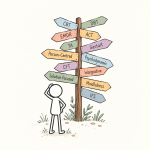
But what do they actually mean, and does it matter which one your counsellor uses?
Therapy models are more than different sets of techniques. They can influence how a therapist understands you, what they think may be contributing to your difficulties, where they believe change comes from, and what they see as their role in the counselling relationship.
So the same problem can be understood, and worked with, quite differently depending on the therapeutic model being used.
There isn't one approach that will be right for everyone. Understanding the differences can help you decide what sounds right for you - but you don't need to have it all worked out before you contact a counsellor.
In this article, we'll look at some of the main therapy models you are likely to come across: what the theory is trying to achieve, how it influences the way a counsellor works, and what that might actually feel like for you in the counselling room.
Person-Centred Therapy
In a nutshell
Person-Centred therapy, developed by Carl Rogers, is based on the belief that you are the expert on your own experience. The relationship between you and the counsellor is central, with empathy, acceptance and genuineness forming the foundation of the work.
What might this look like in the counselling room?
The counsellor is likely to follow your experience rather than direct you towards a particular solution. Reflection and careful listening can help you hear and make sense of your own experience, while you remain the person who decides what fits.
CBT
In a nutshell
CBT focuses on the relationship between thoughts, feelings and behaviours, including negative automatic thoughts and behaviours that may be maintaining a difficulty. It tends to focus on what can be changed in the present.
What might this look like in the counselling room?
CBT is generally structured and more directive than some other approaches. The therapist brings expertise in the model and you may use exercises, worksheets or tasks between sessions to practise different ways of thinking or behaving.
Psychodynamic Therapy
In a nutshell
Psychodynamic therapy explores how earlier experiences and significant relationships may continue to influence how you feel, behave and relate to others now. It pays attention to unconscious processes, repeated patterns and transference.
What might this look like in the counselling room?
The therapist may draw attention to patterns in relationships, including what happens between you and them, and offer interpretations that help you explore how earlier experiences may be showing up in the present.
Gestalt Therapy
In a nutshell
Gestalt focuses on awareness of your whole experience in the present, including thoughts, feelings, bodily sensations and relationships. It also considers how cycles of experience can become interrupted, leaving unfinished business.
What might this look like in the counselling room?
A Gestalt therapist may use experiments to help you explore something rather than only talk about it. These might include noticing bodily responses, repeating or exaggerating a movement, or the famous two-chair experiment.
Experiments are invitations to explore, not exercises you have to get right.
Transactional Analysis
In a nutshell
Transactional Analysis offers ways of understanding how earlier experiences can shape the messages, roles and patterns we carry into adult life.
What might this look like in the counselling room?
TA can help you notice when an old message, role or way of relating is showing up in the present and explore whether it still fits who you are and what you need now.
TA is also often quite explicitly taught within therapy, so your therapist may explain a concept or draw a model to help you understand it. Don't be surprised if they break out the A-frame or start drawing circles representing Parent, Adult and Child!
EMDR
In a nutshell
EMDR is a structured therapy most commonly associated with trauma and distressing memories. It involves bringing aspects of an experience to mind while using bilateral stimulation, with attention moving repeatedly from one side to the other.
What might this look like in the counselling room?
This may involve following a light or the therapist's hand with your eyes, or using alternating sounds or tapping. The therapist usually pauses regularly to check what you are noticing.
DBT
In a nutshell
DBT combines acceptance with change and was developed to help people manage intense emotions, distress, relationship difficulties and behaviours that may be used to cope.
What might this look like in the counselling room?
It is generally structured and skills-based, commonly drawing on mindfulness, distress tolerance, emotional regulation and interpersonal effectiveness.
Solution-Focused Brief Therapy
In a nutshell
Solution-Focused Brief Therapy (SFBT) focuses on your preferred future, strengths, exceptions to the problem and small signs of change rather than spending most of the time analysing the problem.
A well-known intervention is the 'Miracle Question', which asks you to imagine the problem disappeared overnight and explore what you would notice was different.
What might this look like in the counselling room?
The work is future-focused and deliberately brief, using questions to clarify what you want to be different and notice what may already be working.
Want to explore the different approaches in more detail?
The National Counselling and Psychotherapy Society has a guide to a wide range of therapeutic approaches: Search types here
Integrative Therapy - how I work
The basic idea
Integrative therapy isn't simply taking techniques from different therapies and using whichever one seems useful at the time. That would be closer to an eclectic approach.
Integration requires a coherent framework for understanding how different theories fit together and what guides when and why they are used.
At the core of my work
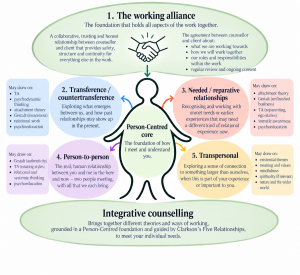
My foundation is Person-Centred. Carl Rogers' six conditions for therapeutic change sit at the core of how I aim to meet and understand the person in front of me.
I am not trying to fit you into a theory or position myself as the expert on you.
How I hold the integration together
My training required me to develop a coherent integrated model: an understanding of how the different theories I use fit together, and what guides when and why I might draw on them.
I use Petruska Clarkson's Five Relationship Model as the framework for thinking about what may be happening between us and what the therapeutic relationship may need to provide at different times.
Where the other models come in
From that Person-Centred foundation and relational framework, I can draw on other theories according to the individual client and what is happening within the work.
Transactional Analysis might help us understand an old relational pattern; a Gestalt experiment might help us explore something happening right now; or a DBT skill might offer a practical way of managing overwhelming emotion.
The important bit
The model doesn't decide what you need.
You, the relationship between us and the work we are doing together inform how I use the models.
Does the type of therapy matter for different problems?
There is evidence that some therapeutic approaches may be more beneficial for particular difficulties than others, and that some approaches may need to be adapted for particular people.
This doesn't mean that there is one 'correct' therapy for everyone with a particular problem.
It is also worth remembering that the therapies we most commonly come across have been shaped not only by research and changing ideas, but also by the needs of the services and organisations delivering therapy.
What is most widely available is not necessarily the same thing as what will suit every individual.
Being as open as you can with a prospective therapist about what you are experiencing, what you hope to get from counselling and any previous experiences of therapy can help them make a fair assessment of whether they are well placed to support you.
Sometimes the most appropriate response from a therapist may be to say that they are not the right person for the work. If that happens, they should be able to explain why and, where possible, help you think about what kind of support or therapist might be more appropriate.
So which type of therapy should I choose?
You don't need to become an expert in counselling theory before choosing a counsellor. Understanding the different approaches can help you know what you might be walking into, but the model is only one part of therapy.
A reasonable place to start is with a therapist you feel you could be comfortable talking to. If something about the therapy doesn't feel right once you begin, talk to your therapist about it.
That conversation can itself become an important part of the work.
Sometimes feeling uncomfortable in the therapeutic relationship may tell us something about patterns, expectations or experiences that are showing up between you and your therapist.
At other times, it may simply be that the therapist's way of working isn't right for you.
A good therapist should be able to explore that with you rather than assuming either explanation. Together you may be able to understand what is happening, adapt the way you are working, or recognise that a different therapist or therapeutic approach would suit you better.
If you are curious about what model of therapy might be a good fit for you, you are welcome to book a free introductory call to see if Integrative Counselling might be your way forward